Sinabis Writeblocker. Read everything. Change nothing.
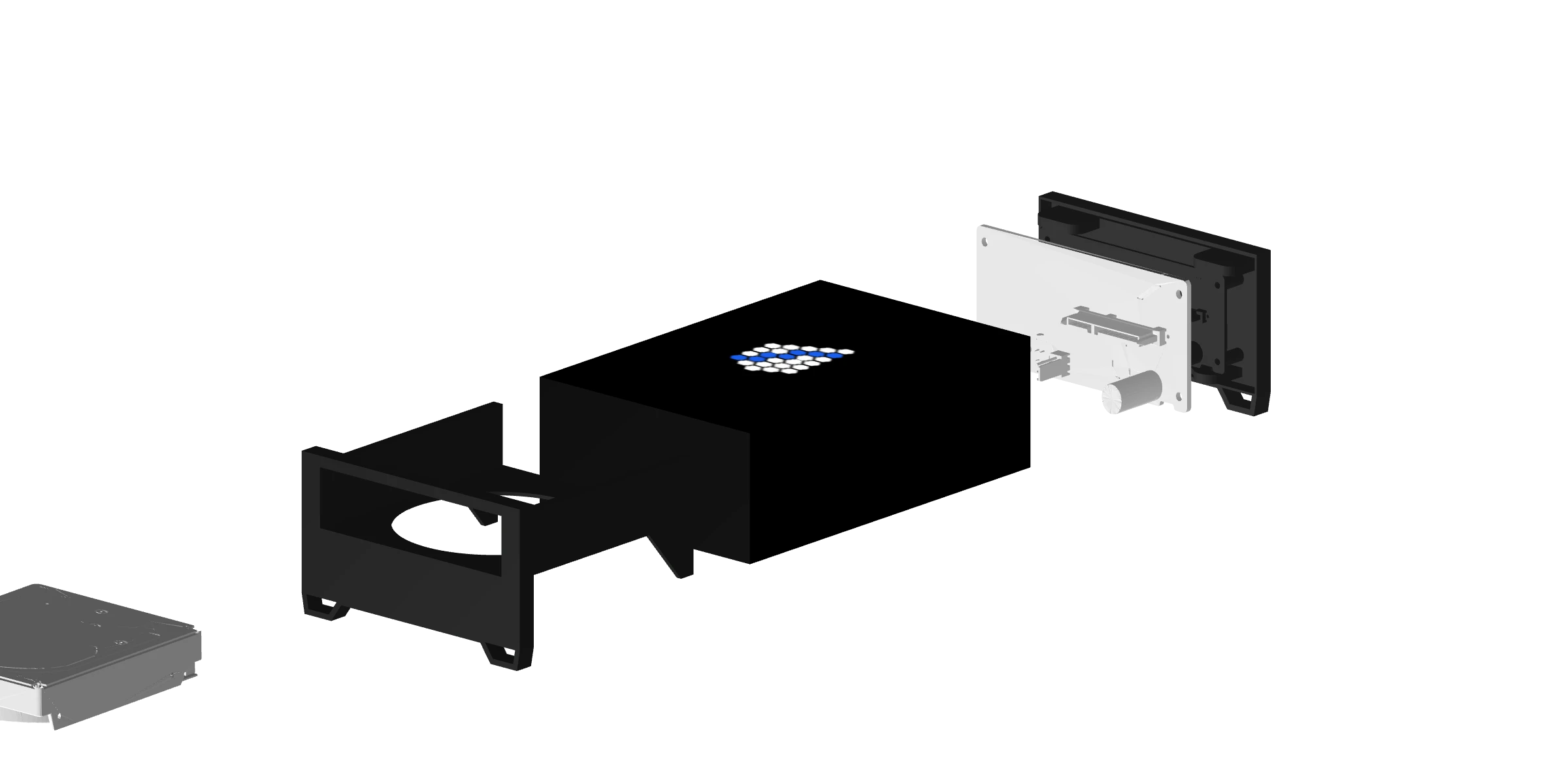
A hardware write blocker that sits between the source drive and your workstation. Reads pass straight through, every write is physically blocked, so the original data stays forensically intact. Available as SATA and USB models.
What is a write blocker?
A write blocker (also written writeblocker, or called a forensic bridge) is a device that sits between a storage medium and the computer. It lets read commands through and blocks every write command. That way a hard drive, an SSD or a thumb drive can be read without the computer being able to write anything to the original.
It is used in digital forensics and wherever data is preserved as evidence. Simply connecting a drive to an ordinary computer changes it: the operating system mounts it, updates timestamps, creates system folders or repairs the file system. After that nobody can show that the data is still in the state in which it was seized.
With a write blocker the examiner creates a forensic image instead, a bit-for-bit copy of the drive. Hash values of the original and the copy show that the two match, and all analysis then happens on the copy.
Guide: what is a write blocker?Write protection in hardware, not software.


Order your Writeblocker.
SATA and USB models are available in the Sinabis Analytics shop. Talk to us about volume orders and forensic tooling.

Available Monday to Friday, 9:00 to 18:00 (CET).
Technical details.
Test reports.
No sectors on the drive were modified during the test.
Open report
No sectors on the drive were modified during the test.
Open report
Both models were tested with the Federated Testing method of the NIST CFTT program. The reports are published in the CFTT list of test results.
View NIST listFrequently asked questions
What we get asked most often about this topic. If your question is missing, write to office@sinabis.com.
A device placed between a storage medium and the analysis computer that allows read access but blocks every write command, so the original data cannot be altered. It is also written writeblocker or called a forensic bridge.
For the forensic acquisition of storage media. An ordinary computer writes to a drive as soon as it is connected, for example timestamps or system folders. The write blocker prevents that, so a bit-for-bit image can be made and the original stays unchanged as evidence.
A software write blocker runs on the analysis computer and depends on its operating system behaving correctly. A hardware write blocker enforces read-only at the interface, independent of the host, its drivers and its configuration.
The SATA model handles 2.5" and 3.5" SATA hard drives and SSDs. The USB model handles USB mass storage such as external drives and thumb drives. Both connect to your workstation over USB.
Connect the drive to the write blocker, the write blocker to the computer over USB and to its power supply, then start imaging. No drivers or additional software are needed.
Yes, with an SSD it also blocks every write command from the computer. Internal processes of the SSD such as garbage collection run inside the drive itself, though, and no write blocker can stop them. That is why an SSD is imaged as soon as possible after it is seized.
The write blocker is the technical precondition: it makes sure the original is not changed. Hash values that show the original and the image match and complete documentation of the acquisition belong to it as well.
Yes. Both models were tested with the Federated Testing method of the NIST CFTT program, and no sectors on the drive were modified. The test reports are on this page and in the CFTT list of test results.
The SATA model costs €199, the USB model €199, each including 19 percent VAT. You order directly in the shop on this website; for larger orders reach sales at sales@sinabis.com.