AI for Everyday Operations: The Unglamorous Work Nobody Writes About
AI · September 30, 2026
Most of what AI is genuinely good for at work is too boring to make a case study. That is exactly why it never gets approved.
Almost everything written about AI at work describes a big moment. A mountain of evidence reduced to a timeline. Years of archived email searched in an afternoon. A transformation with a clear before and after.
Those moments are real, and we build tools for them. But they are not what most people in an organisation need help with on a Tuesday afternoon. What they need is to find one clause in a contract signed two years ago by someone who has since left. That task is too small to write about, too frequent to ignore, and almost never part of anyone’s digital strategy.
This is the part of AI that gets no attention: everyday operations. The unglamorous document work that fills a working week at any organisation handling more paper than it can remember.
I. The Work That Actually Fills the Day
Across the organisations we work with, the same handful of tasks come up again and again. None of them is dramatic. Together they consume more hours than any single project on the roadmap.
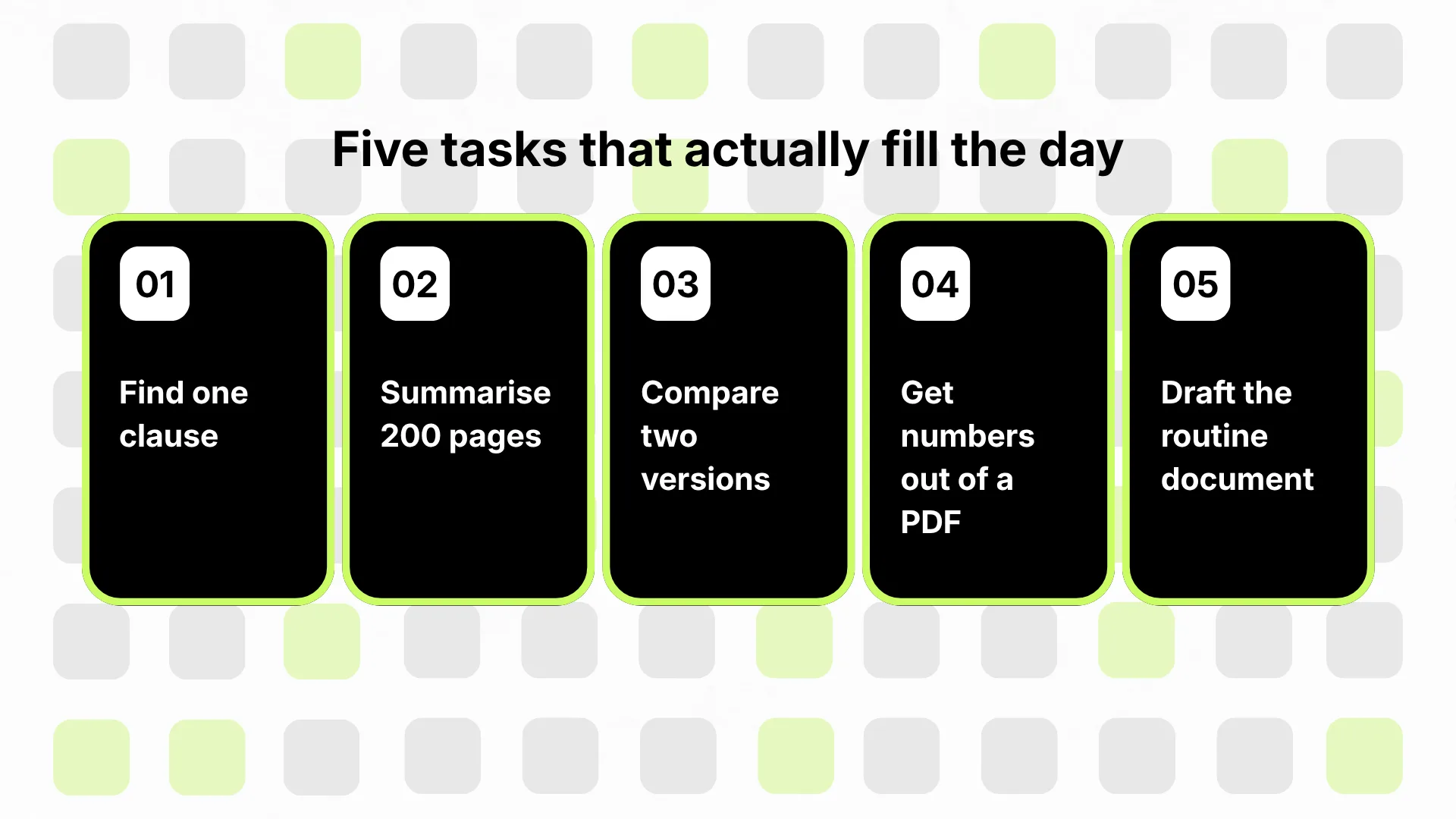
1. Finding one clause in an old contract. The framework agreement exists. Somebody knows roughly when it was signed. Nobody remembers whether the notice period was three or six months, and the file name gives no clue. Still needs a person: read the clause in full before acting on it. The answer tells you where to look, not what to do.
2. Summarising a long document you did not write. A 200-page tender, an audit report, a technical specification from a supplier. You do not need to read all of it; you need to know which four pages concern you. Still needs a person: check the summary against the source before quoting it to anyone.
3. Comparing two versions of the same document. Version 7 arrived. Version 6 is the one you agreed to. What changed? Track Changes only helps if everyone used it, and they did not. Still needs a person: judge which of the differences actually matter commercially.
4. Getting numbers out of a PDF. A supplier invoice, a price list, a delivery note. The figures exist, but as a picture of a table. So somebody retypes them into Excel. Still needs a person: spot-check the extracted figures; a misread digit is worse than no figure at all.
5. Writing the first version of a routine document. A status report, a meeting summary, a standard reply that is ninety percent the same as last month’s. The blank page costs more time than the writing. Still needs a person: own the final text. A draft is a starting point, not a submission.
Notice what these have in common. Every one is a document task rather than a thinking task. Every one has a verifiable answer, checkable in seconds. And every one takes between ten minutes and an hour, several times a week, for a lot of people at once.
II. Why Nobody Ever Funds This
Here is the strange part. Organisations approve large projects and ignore small savings, even when the small savings are worth more.
Take a simple example. A €40,000 system gets a business case, a decision paper and a signature. It has an owner. It appears in a budget line. Twenty minutes a day spread across forty people belongs to nobody. There is no owner to write the paper, because nobody experiences it as a problem, everybody experiences it as work.
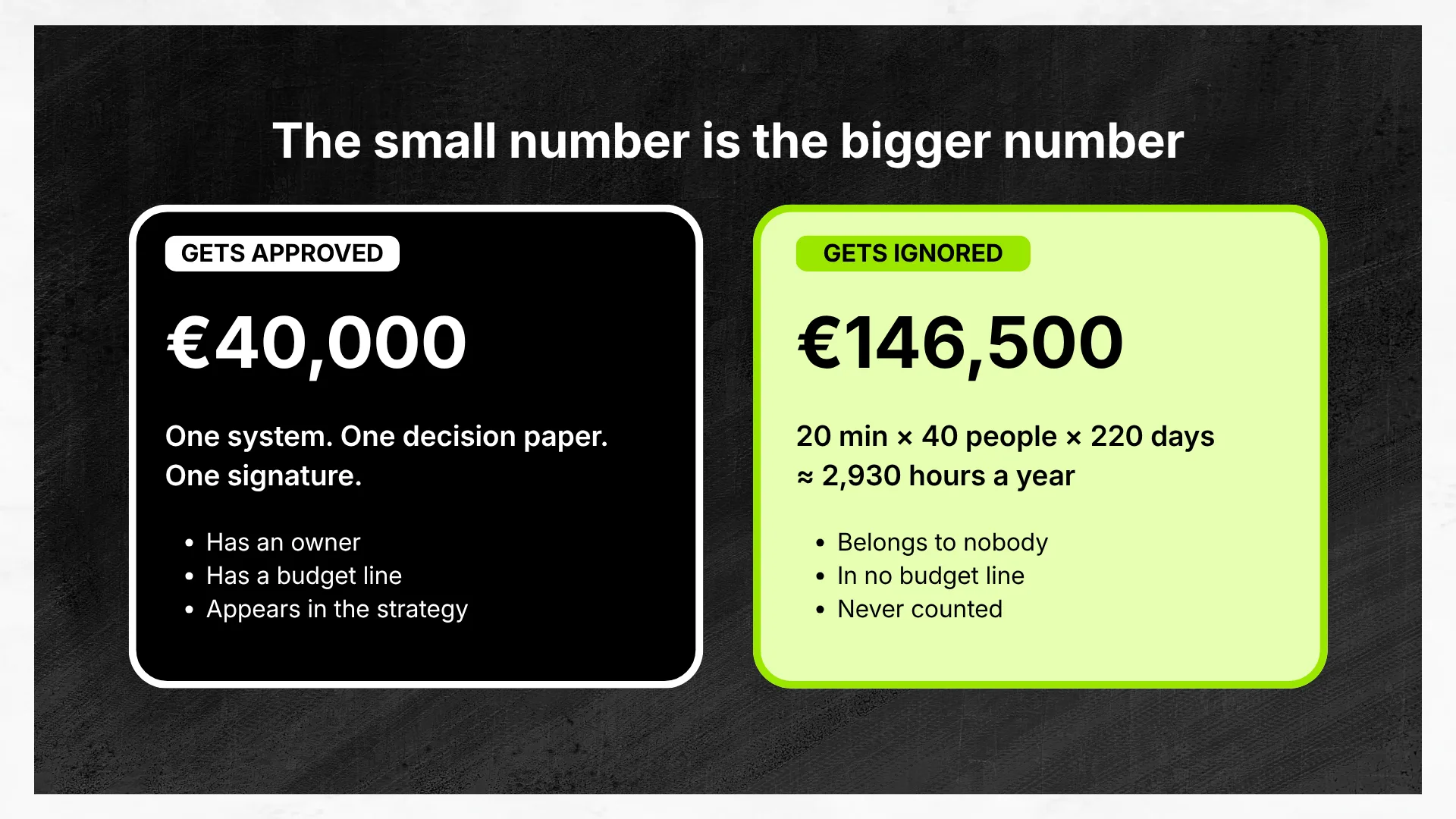
It is worth doing the arithmetic once, because it is not close.
20 minutes × 40 people × 220 working days ≈ 2,930 hours a year. At a fully loaded €50 an hour, that is roughly €146,500 every year. Invisible, unbudgeted, and larger than most of the projects that do get approved.
(The figures above are a worked example, not a measurement. They are not Sinabis data and they do not describe any real organisation.)
The numbers will differ at your organisation. The shape almost never does. Which suggests a different question to ask when planning: not which big process should we automate, but what does everyone here do twenty times a week that nobody has ever counted?
III. “Everyday” Is Not the Same as “Low-Stakes”
There is a quiet assumption behind a lot of AI adoption: that everyday operations are low-stakes compared with legal or investigative work, and can therefore use whatever public tool is convenient. Case files get a governance discussion. Tuesday’s admin gets a browser tab.
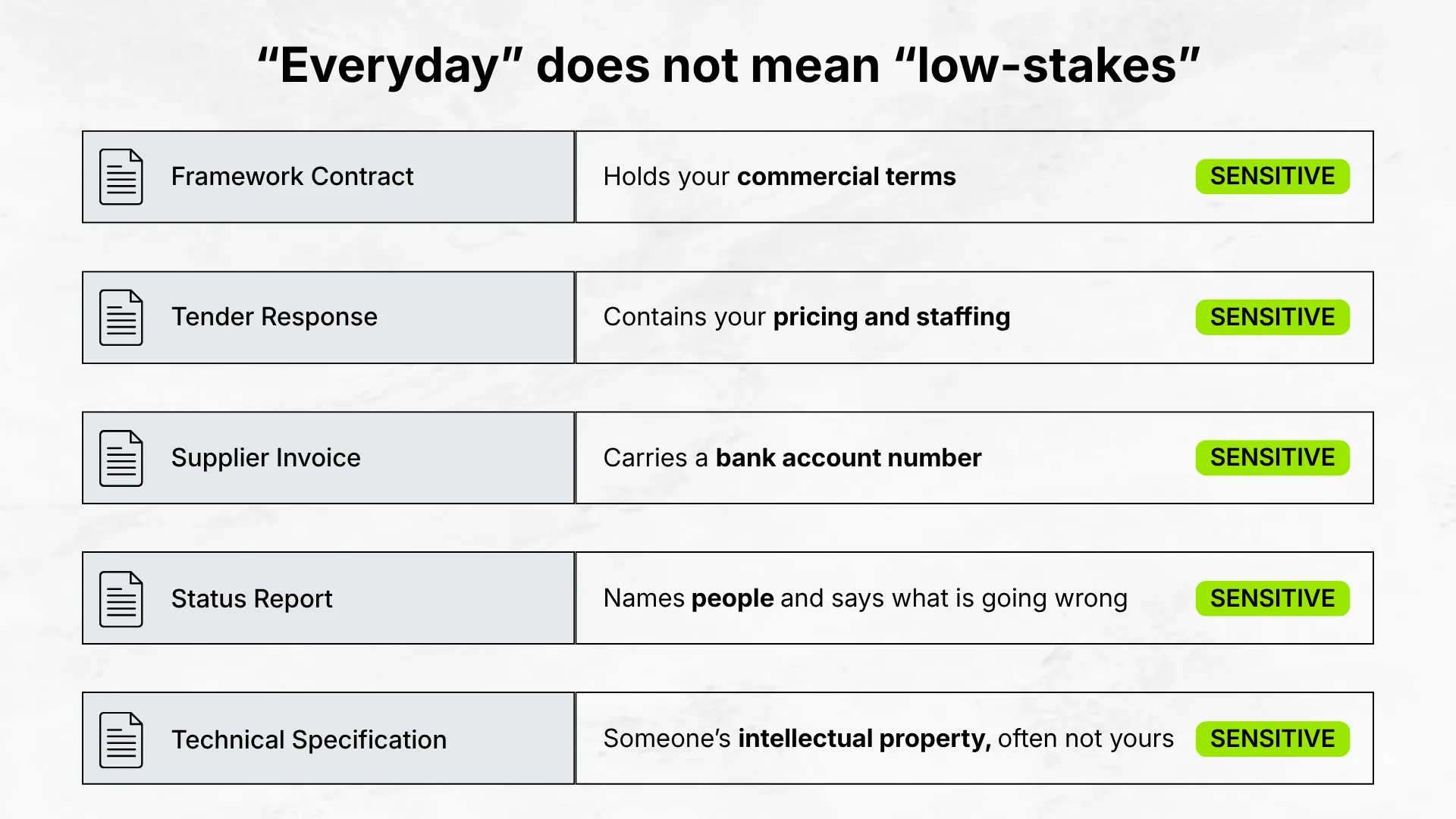
Look at the five tasks again and the assumption falls apart. A framework contract holds your commercial terms. A tender contains your pricing and your staffing. A supplier invoice carries a bank account number. A status report names people and describes what is going wrong. A specification is someone’s intellectual property, often not yours.
Feed any of those into a public AI service and you have made a data transfer decision, usually without anyone recording that a decision was made at all. The GDPR obligations that apply to the case file apply here too. The only difference is that nobody held a meeting about it.
So everyday operations is not a lower tier of data protection. It is the same tier, handled with less attention.
IV. What This Looks Like With Sinabis
Sinabis Assistant was built for exactly this layer of work. You ask a question about your own documents in plain language and get an answer together with the passage it came from, so you can verify it in the time it takes to read one paragraph. It summarises long files, compares documents against each other, pulls structured figures out of PDFs and scans, and drafts back out into Word or Excel when the answer has to become a document. Contracts, tenders, email archives, scanned paper: the formats that usually break tools.
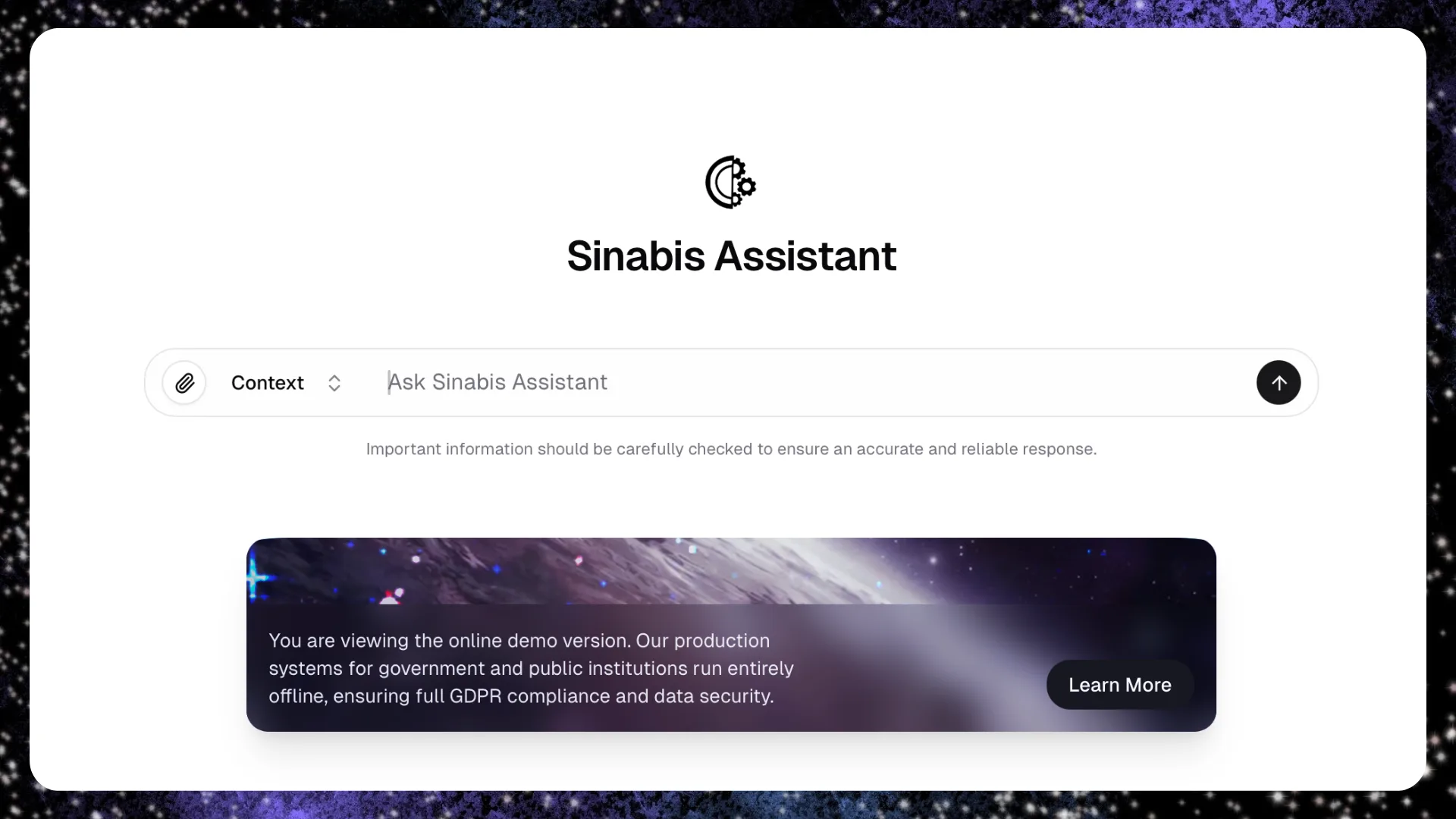
The part that matters most is where it runs. Everything Sinabis builds starts from one principle: you should not have to give up control of your data to get the benefit of AI. Not for a case file, and not for an invoice. Data sovereignty is not a feature we added for regulated customers; it is the premise the whole portfolio is built on.
That premise takes two shapes:
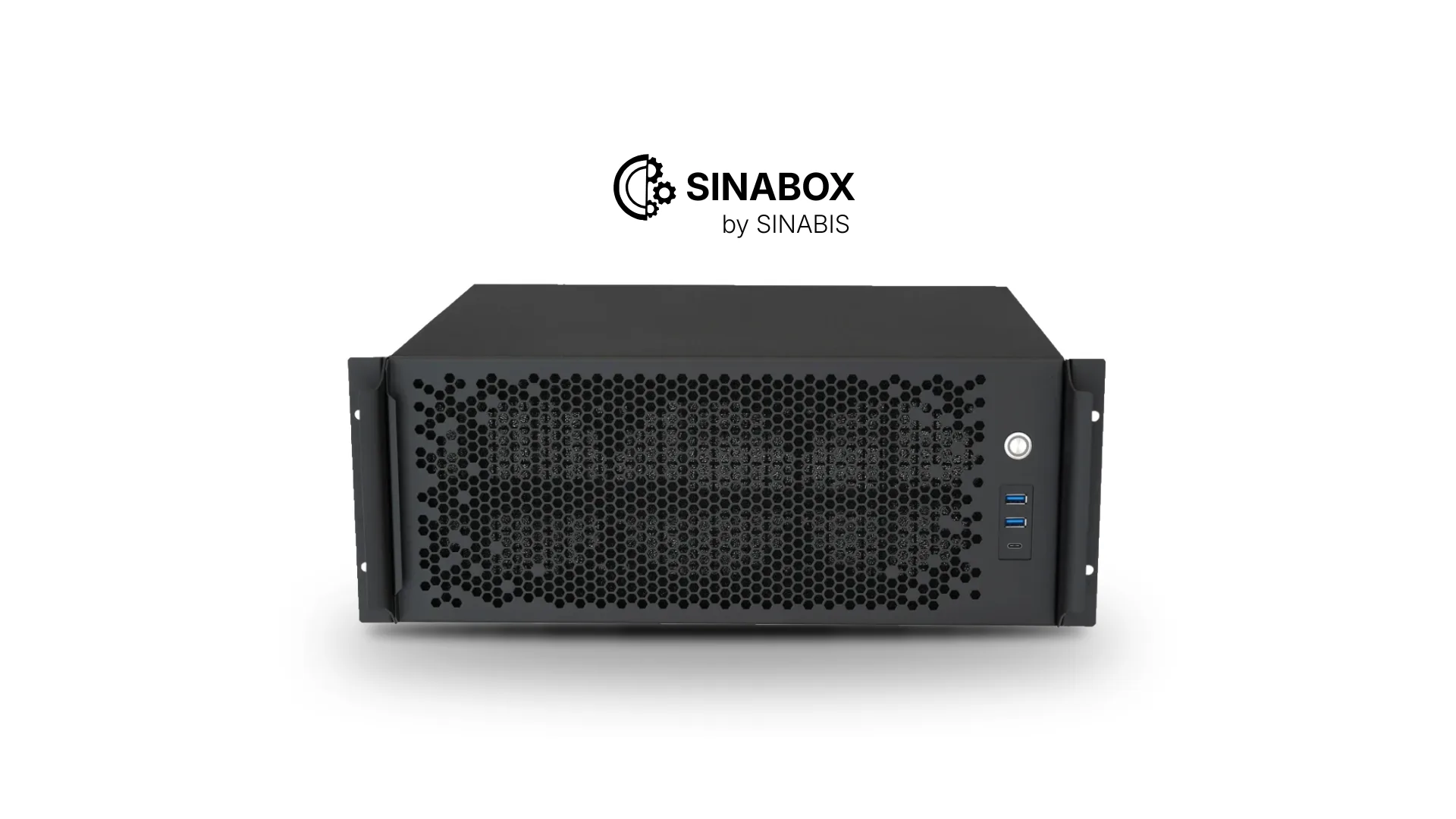
1. Sinabox: The appliance in your own building. Fully offline and air-gapped, with no external connection. Not a single byte leaves your network.
2. Sinacluster: EU-hosted, run by Sinabis. An encrypted connection to European data centres, for teams where a managed platform fits better than hardware on site.
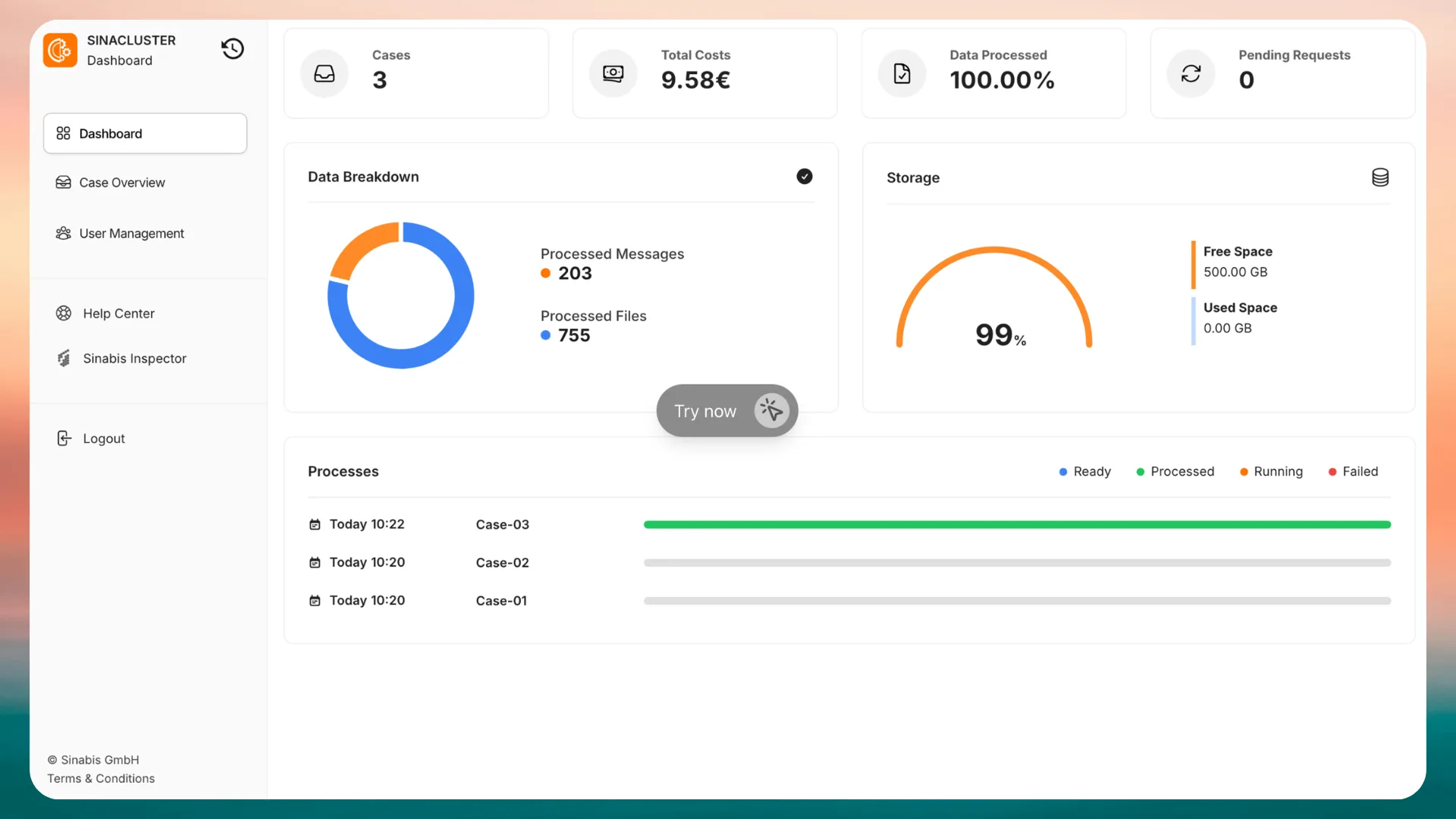
Both run open-weight models on infrastructure you control. No providers outside the EU, no third-party model training on your documents, no black box. The AI capability is the same either way; the only question is where your documents are while the work happens. That question deserves the same answer for the twenty-minute task as for the twenty-week investigation.
The best argument for doing this properly is not the landmark case. It is the forty people who will each save twenty minutes tomorrow, using documents that never left the building.
Wondering which everyday tasks at your organisation are worth starting with? Get in touch here. Or see how this works for business and for the public sector.
→ Learn more: www.sinabis.com
Sinabis Analytics GmbH · X64 Forensic GmbH · X64 Systems GmbH
Jui Mehta