Three Ways to Process Sensitive Data Securely: Which Option Is Right for Your Organisation?
Big Data · September 1, 2026
Any organisation that handles sensitive data eventually faces the same question: where does the data actually go when it needs to be processed? That question matters more than ever in 2026. Whether you work in healthcare, finance, law enforcement, digital forensics, government, or any other field where data cannot fall into the wrong hands, the answer to that question has real legal and operational consequences.
Under GDPR, NIS2, and the EU AI Act, organisations need to know exactly where their data is processed, who can access it, and whether it ever leaves their control. Choosing the wrong processing setup can create compliance problems, compromise an investigation, or put patient, client, or financial data at risk.
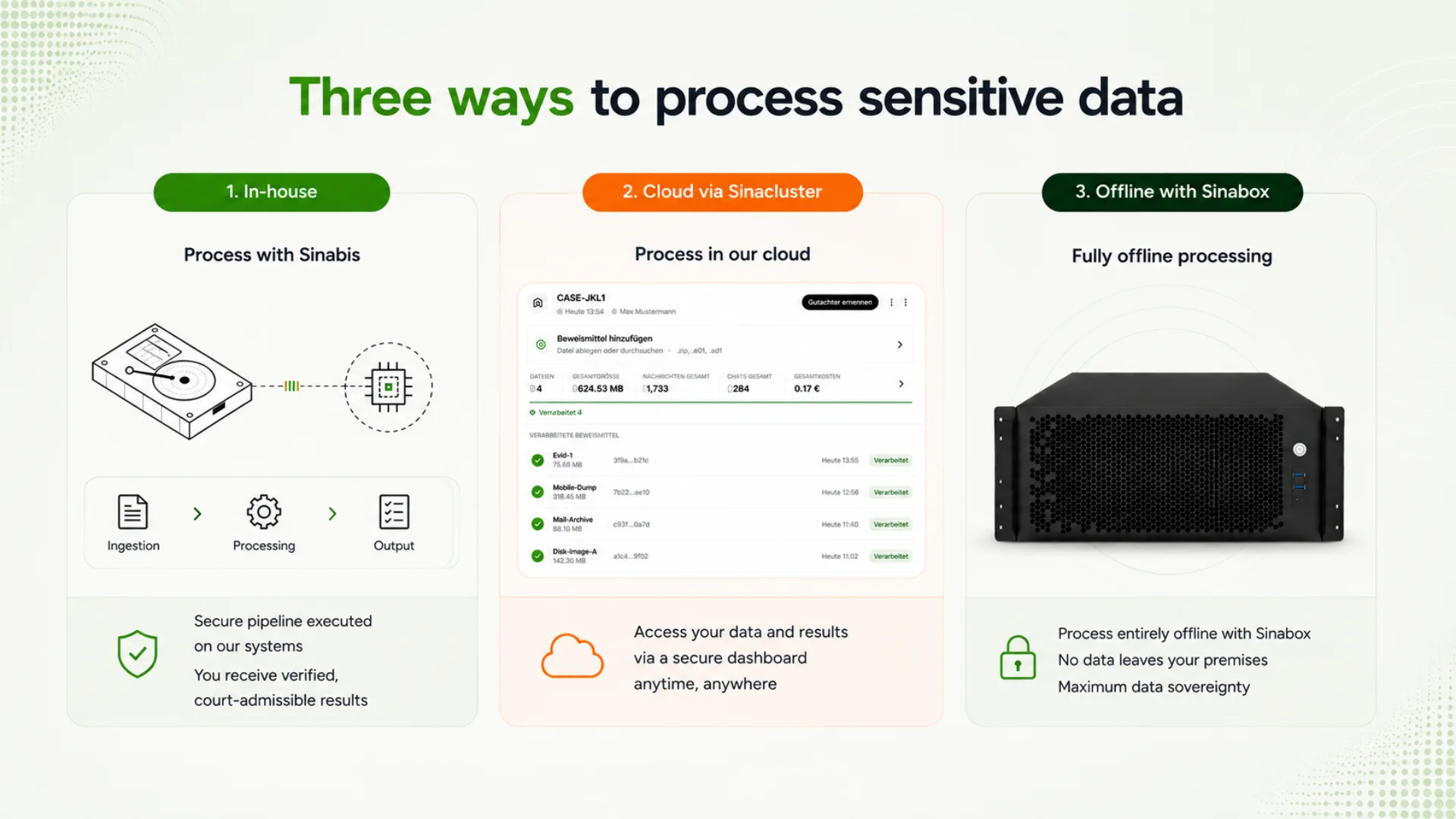
At Sinabis, we offer three ways to process sensitive data. Each option is built for a different set of requirements, but all three deliver the same outcome: fast, accurate, AI-powered analysis that is ready for legal proceedings, regulatory review, or internal decision-making.
This guide explains all three in plain language so you can work out which one fits your organisation.
What Is Data Processing Infrastructure?
Data processing infrastructure is the system an organisation uses to collect, organise, search, and make sense of large amounts of data. In a hospital investigation, that might mean going through years of patient correspondence to identify a pattern. In a fraud case, it might mean searching thousands of financial records for specific transactions. In a criminal investigation, it might mean processing emails, documents, and audio files from multiple devices to find relevant evidence.
In the past, this kind of work took weeks and required large teams doing manual review. Today, AI-powered tools can do the same work in hours. They can extract text from any file format, search by keyword or concept, transcribe audio recordings, detect patterns across large datasets, and produce a clear audit trail.
The challenge is not finding a tool that can process data. It is finding one that does it without creating a compliance problem. Routing sensitive patient data, financial records, or legal evidence through an unsecured or non-EU cloud platform can violate data protection rules and undermine the integrity of the processing itself. That is why the choice of infrastructure matters so much.
The question is not just whether a tool can process your data. It is whether it can do so without your data leaving your control.
Option 1: Processing by Sinabis (We Handle Everything)
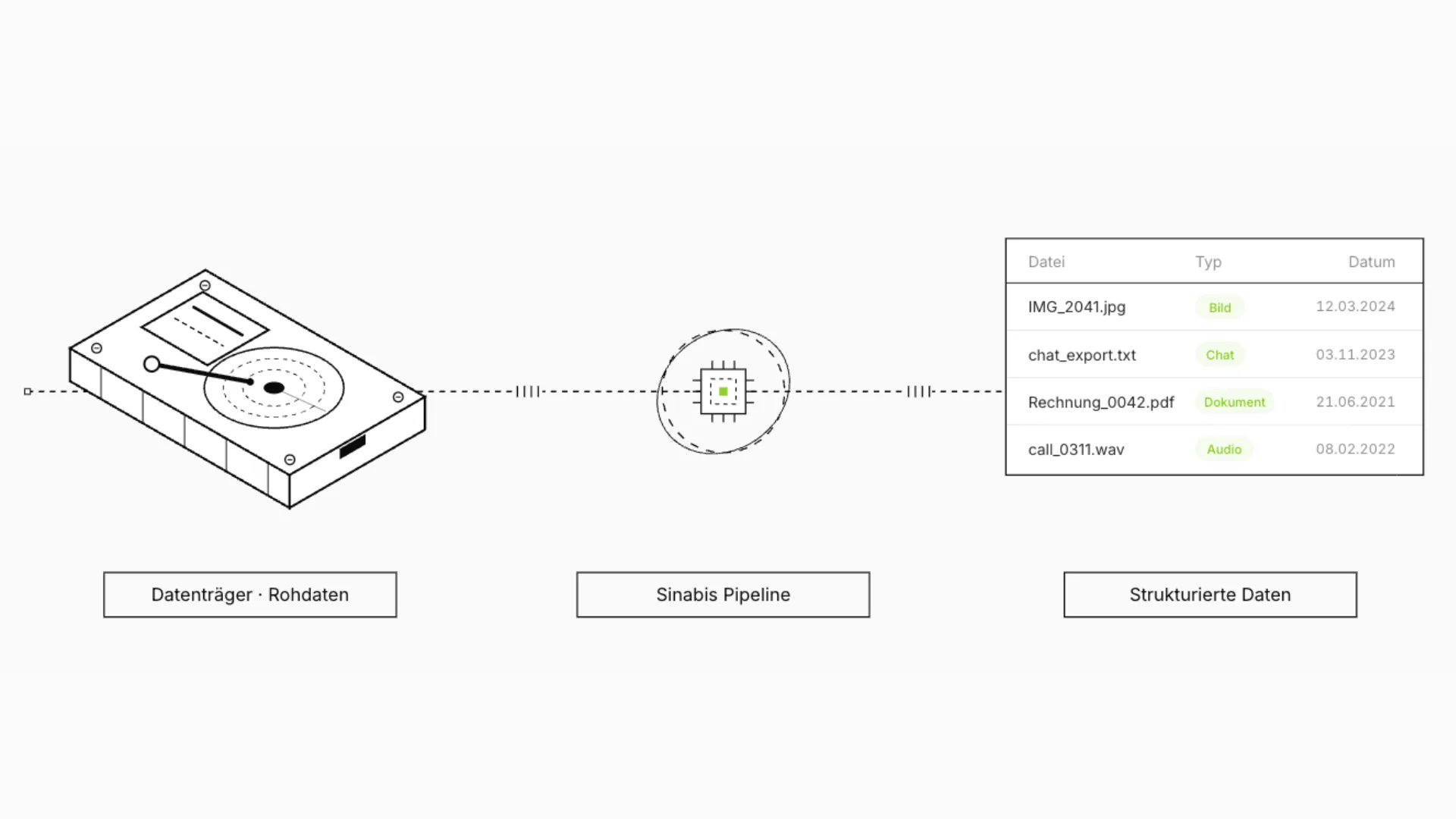
The simplest option is to hand the data or evidence over to the Sinabis team and let us handle the entire processing job. You do not need to set up any software, manage any platform, or assign internal staff to the work. You receive structured, searchable, court-admissible output at the end.
This works for any organisation that has a specific dataset that needs to be processed but does not have the internal tools or capacity to do it. It could be a hospital that needs to search a decade of patient correspondence as part of an internal review. It could be a bank that needs to process email archives for a regulatory inquiry. It could be a law enforcement agency dealing with a major investigation, or an insurance company reviewing claims data for a fraud case.
When data arrives at Sinabis, it enters a forensically controlled environment. Every step is documented. Original files are never modified. Hash values confirm that nothing has changed at each stage. Processing always happens on a copy of the data, not the original. The output comes with a complete chain of custody record that can withstand scrutiny in court or in a regulatory review.
The types of data we can process include:
1) Emails in all major formats: Outlook, Lotus Domino, EML, MBOX, and others
2) Documents in Office and LibreOffice formats, PDFs, scanned files processed with OCR
3) Forensic containers in formats including AD1, E01, EX01, and L01
4) Encrypted archives including ZIP, 7z, and RAR files
5) Audio recordings transcribed with full timestamps and keyword search
6) Data from smartphones, computers, external drives, and servers
7) Financial records, spreadsheets, and structured data exports
The output is a structured, searchable dataset with keyword extraction, document classification, topic detection, and a full audit trail. It is ready for legal review, regulatory submission, or internal analysis.
Hand over the data and we handle the rest. You get accurate, court-ready results without managing any part of the process yourself.

Learn more about in-house processing →
Option 2: Processing via Sinacluster (Secure, Scalable, EU-Hosted)
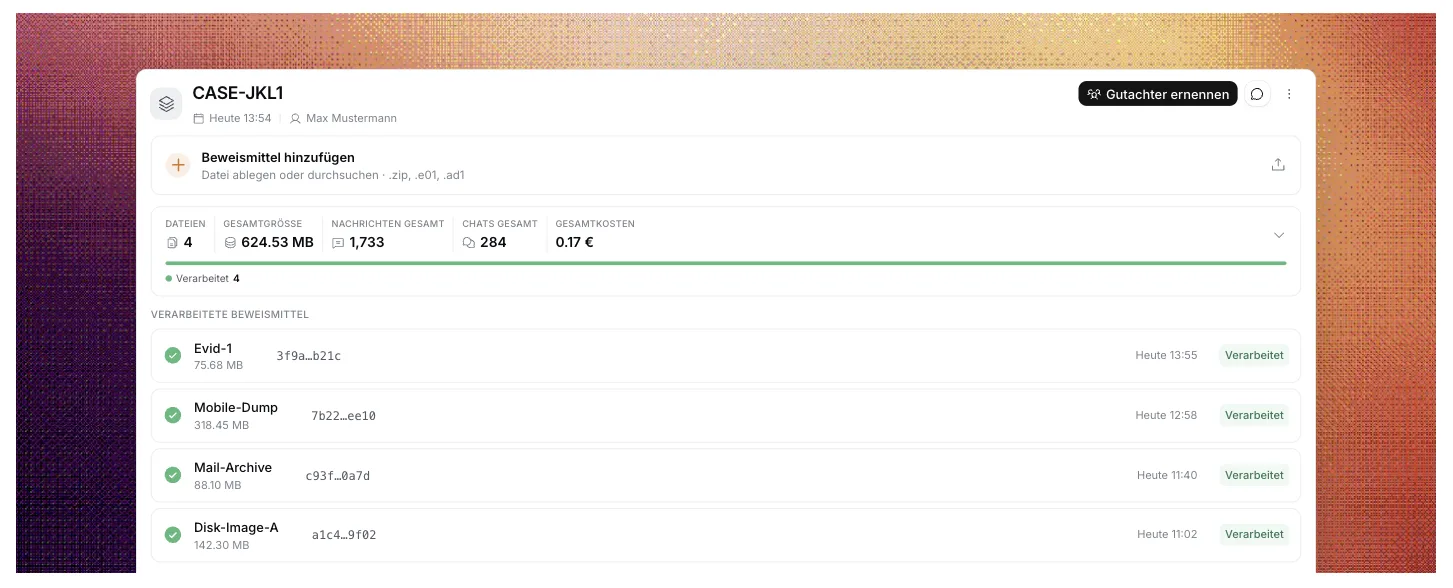
Sinacluster is for organisations that want to manage their own data processing workflow but need a secure, scalable platform to run it on. Instead of sending data to a public cloud tool, you connect to Sinacluster through a secure VPN and upload the data directly. From there, all processing happens inside a certified data centre in Germany.
Your data stays within the EU, under German and European law, at all times. This is particularly important for organisations in regulated sectors where data cannot leave a specific jurisdiction. A hospital cannot send patient data to a cloud provider with servers outside the EU. A government body cannot route classified operational data through an uncontrolled platform. Sinacluster is built for exactly these situations.
Once data is uploaded, your team gets access to a full set of AI-powered tools. Keyword search and semantic search let you find relevant content even when documents do not contain the exact words you searched for. Automatic text extraction works across hundreds of file formats. Audio transcription turns recordings into searchable text. Topic modelling groups documents by theme. Timeline reconstruction assembles a picture of events from fragmented sources. And every action is logged automatically, producing an audit trail that meets the standards of legal proceedings.
Sinacluster works well for:
1) Hospitals processing large volumes of patient correspondence for internal reviews or legal matters
2) Financial institutions running analytics on transaction data or preparing for regulatory audits
3) Law firms managing large-scale eDiscovery across multiple cases at the same time
4) Digital forensics units handling several investigations simultaneously
5) Government departments that need scalable, EU-hosted processing with AI capabilities
6) Any organisation that needs to process large datasets regularly without managing its own hardware
Sinacluster gives your team enterprise-level AI processing tools running inside a certified German data centre, with a full audit trail and no data leaving EU jurisdiction.

Learn more about Sinacluster →
Option 3: Sinabox (Process Everything Offline on Your Own Premises)
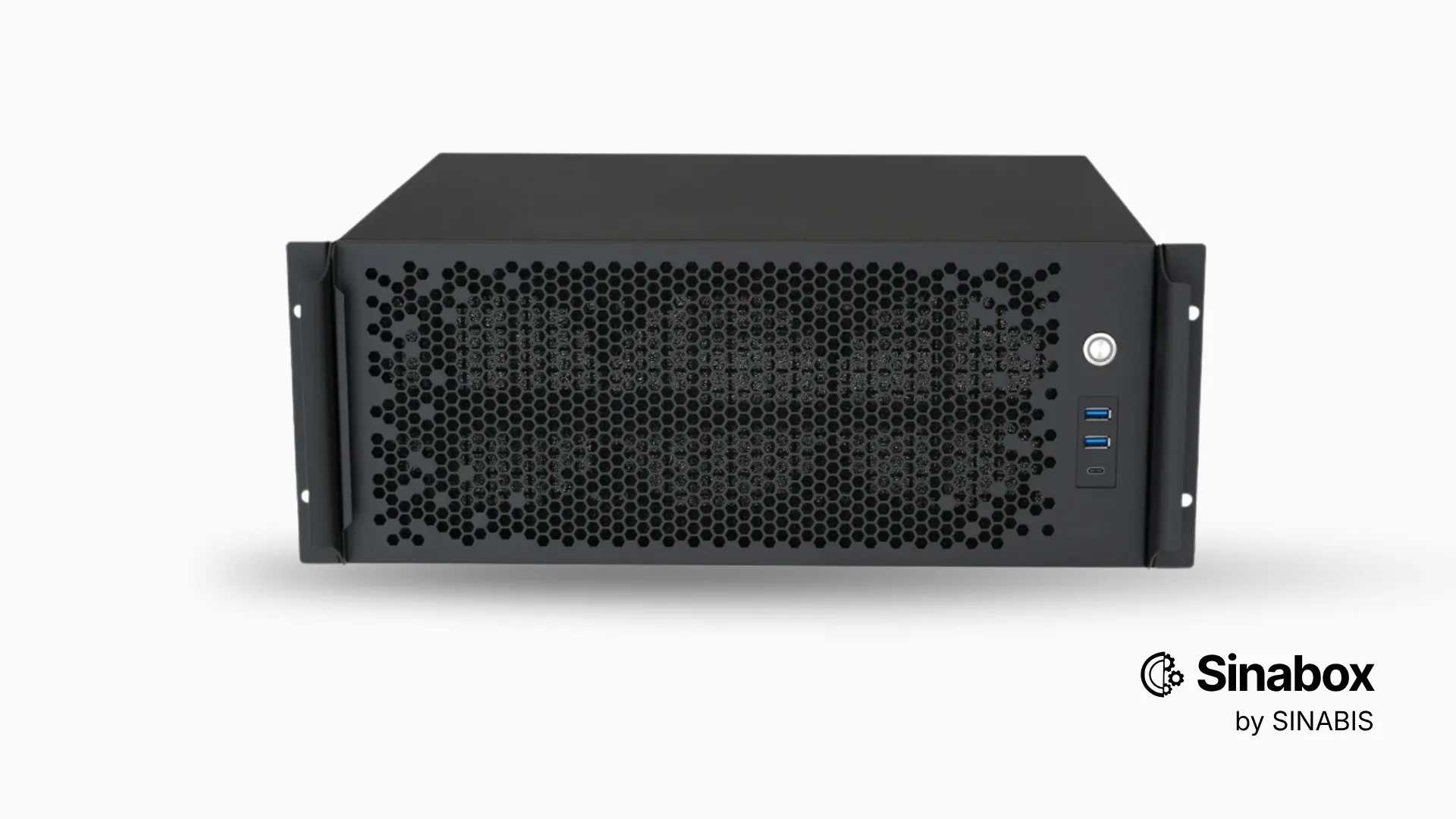
Sinabox is for organisations where data cannot leave the building under any circumstances. It is a self-contained processing unit that you receive and connect to your own infrastructure. Everything runs offline. No internet connection is needed. No data is sent anywhere external. It all stays inside your premises, under your control.
The capability of Sinabox is identical to Sinacluster. Your team gets the same keyword search, semantic search, document classification, audio transcription, topic modelling, and evidence management tools. The interface is the same. The output format is the same. The forensic and legal standards are the same. The only difference is that all of it runs on hardware sitting inside your own environment.
This matters for organisations that have strict operational or legal requirements around data leaving their premises. It also matters for organisations in environments where internet access is limited or unavailable, such as secure facilities, field deployments, or air-gapped networks.
Sinabox is particularly suited to:
1) Hospitals and healthcare providers where patient data cannot leave the organisation's own infrastructure
2) Banks and financial institutions with strict internal data sovereignty policies
3) Government agencies and intelligence units with classified data requirements
4) Law enforcement and forensics teams working in secure or restricted environments
5) Courts and legal institutions that cannot route evidence through external systems
6) Enterprises in heavily regulated sectors preparing for CADA and NIS2 enforcement
7) Any organisation where full on-premise control of data processing is a hard requirement
In 2026, Sinabox is becoming more relevant not just for government and intelligence environments but for any organisation that wants to be ahead of the data sovereignty requirements coming under the EU Cloud and AI Development Act, which is targeting formal agreement by end of 2027.
Sinabox brings full AI-powered data processing inside your own walls. No internet connection, no external servers, no data ever leaves your environment.

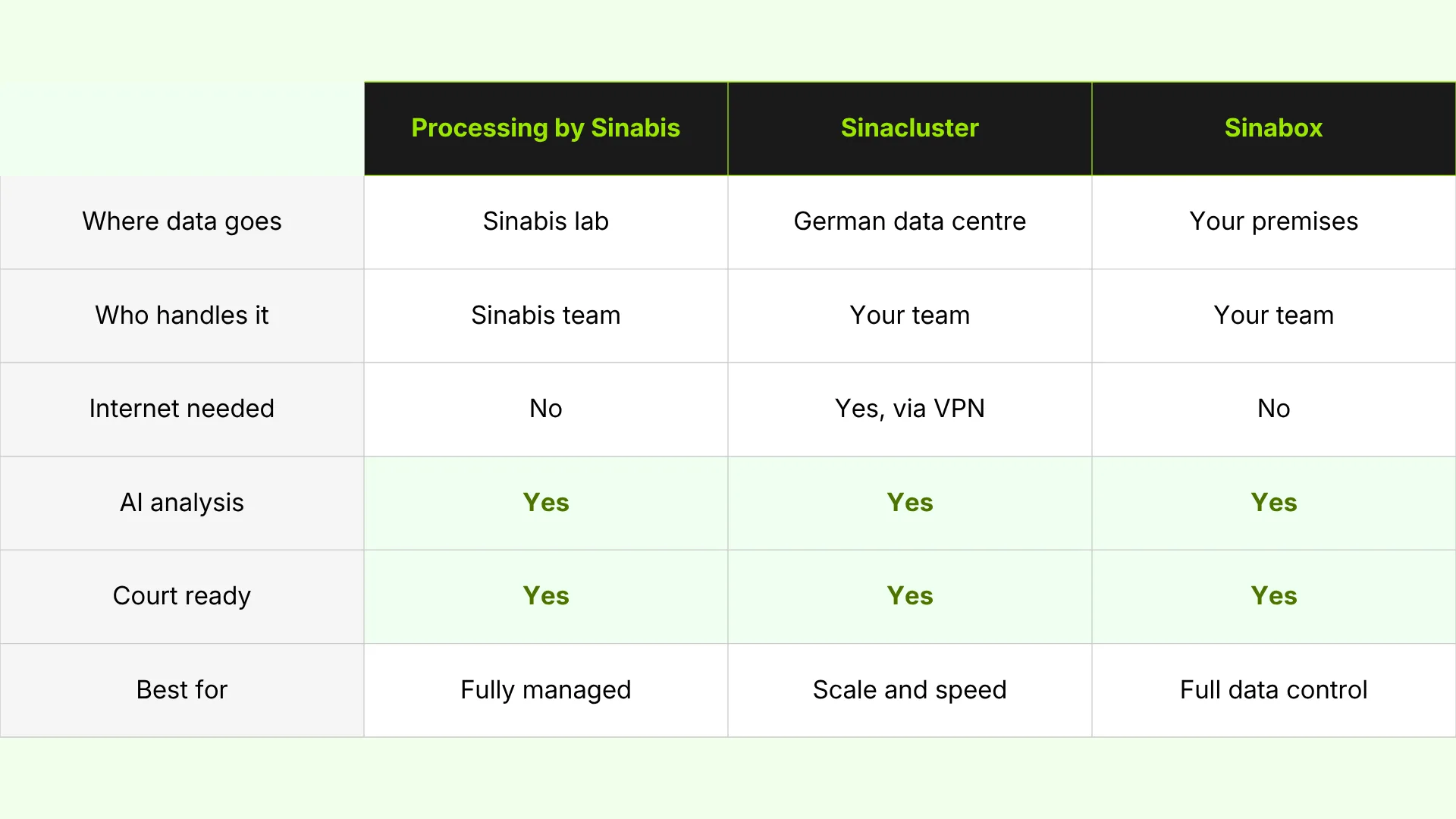
A Quick Comparison of All Three Options
All three options produce the same quality of output. The right choice depends on where your data needs to stay, how much you want to manage yourself, and what your compliance requirements look like.
Four Questions to Help You Decide
First, where does your data need to stay? If it cannot leave your building, Sinabox is the right answer. If it can go to a certified EU data centre, Sinacluster gives you more scale and flexibility. If you just need results without managing the process, in-house processing by Sinabis is the most straightforward option.
Second, how often do you need to process data? If it is a one-off case or a specific dataset, in-house processing avoids the overhead of setting up a platform. If you have ongoing and recurring processing needs across your organisation, Sinacluster or Sinabox will serve you better over time.
Third, what is your team's technical capacity? All three options are designed to be straightforward to use, but Sinacluster and Sinabox require someone to manage the workflow. If your team is already stretched, letting Sinabis handle the processing removes that internal burden entirely.
Fourth, where are your compliance requirements heading? Regulations around data processing in Europe are getting stricter. Organisations in healthcare, finance, legal services, and the public sector are all facing tighter rules. Choosing infrastructure that is already built for the coming regulatory environment is a better long-term investment than having to change later.
Key Takeaways
1) Any organisation that handles sensitive data can benefit from secure data processing infrastructure, not just law firms or forensics teams
2) Sinabis offers three options: in-house processing, Sinacluster, and Sinabox, covering every level of data sovereignty requirement
3) All three options use AI-powered tools and produce court-admissible, forensically documented results
4) In-house processing by Sinabis suits organisations that want results without managing the process
5) Sinacluster suits organisations that need scalable EU-hosted processing with full team control
6) Sinabox suits organisations where data cannot leave their own infrastructure under any circumstances
7) The right choice depends on data sensitivity, processing frequency, internal capacity, and compliance trajectory
Not sure which option fits your organisation?
Our team works with organisations across healthcare, finance, law enforcement, legal services, digital forensics, government, and enterprise. We are happy to help you work out which setup makes the most sense for your specific situation.
Get in touch: sinabis.com/contact
Sinabis Analytics GmbH · X64 Forensic GmbH · X64 Systems GmbH

Fatima Naz